How to get Connected, #SocialConf and new beginnings
Some updates which I wanted to share with you from the last week.

If you’re interested in how online communities come together to get stuff done, make change happen and have the power to impact on people’s day to day lives then you might like to sit back with a new Guardian Short which I’ve co-written with Ed Walker and Marc Thomas.
I’ve worked with Ed and Marc in a number of capacities – and here we’ve combined our experience and understanding of what makes community projects online work (and not work), as well as choosing some of our favourite (and lesser known) examples of communities and projects which are both inspiring and have made a difference in the area around them – all in a very short and (we hope) engaging read. It’s perfect for a Sunday evening so go and put the kettle on, climb into a comfy chair and download the ebook here: http://guardianshorts.co.uk/connected/ Read the rest of this entry »
A potted history of community management (and a bright future) – notes from #Vircomm13
In 1996 in San Francisco John Coate was busy coodinating online communities around hyperlocal content. Three years later, Robin Hamman was putting together the BBC manual for ‘online community management’ to help the company navigate through a new world of ‘hosting’ conversatons on message boards and webchats.
The world of dial up modems, lumberjack shirts and floppy disks feels like a long time ago, but the art of community management remains founded on the same principles which made Coate’s The Well and Hamman’s early insights in comment boards successful – transparency, openness, being responsive and affirming members. As Coate summed up:
“It was real people talking about real things that matter to them – that’s why it all mattered.”
On Thursday community and social media managers from London and beyond gathered at the Virtual Community Summit to look back at how far engaging online communities as a practise had come – and gather thoughts on what might lie ahead.
Coate and Ramman took us through their personal history in community engagement with keynote talks – baring stark similarities despite spanning decades and international waters.
But other panel discussions hinted at darker areas of unknown which are growing up with new young digital natives. Dave Miles from the FOSI explained that while new and brilliant tools and technologies emerge, there is a generational gap in online skills preventing parents from being fully equipped to use these tools to protect their children online against safety risks. Sarah Drinkwater from Google’s Local intiative gave a vision for the future – moving from a time when adults read and consumed content, to 30-somethings who read, recommend and share content, to teenagers today who expect to create, share and collaborate on content.

Sarah Drinkwater’s look at content creation for different generations. Photo: HRW
Today, the role of the community manager seems to now be somewhat all encompassing – including aspects of customer care, marketing, brand development and journalism – maybe it always has done. Community managers continue to debate whether they are social media managers and defining job descriptions, and are struggling to manage management and client expectations – highlighted with Tom Messett’s slew of real examples such as regular emails asking “Hi Tom, can we get some Facebook on this?” With a knowledge gap when it comes to online engagement (alongside a continuing lack of tools to track ROI from community) as well as advances in technology making sure brands keep on their toes – Tamara Littleton highlighted KLM and Lego as good examples of brand engagement – and come prepared for social crisis management.
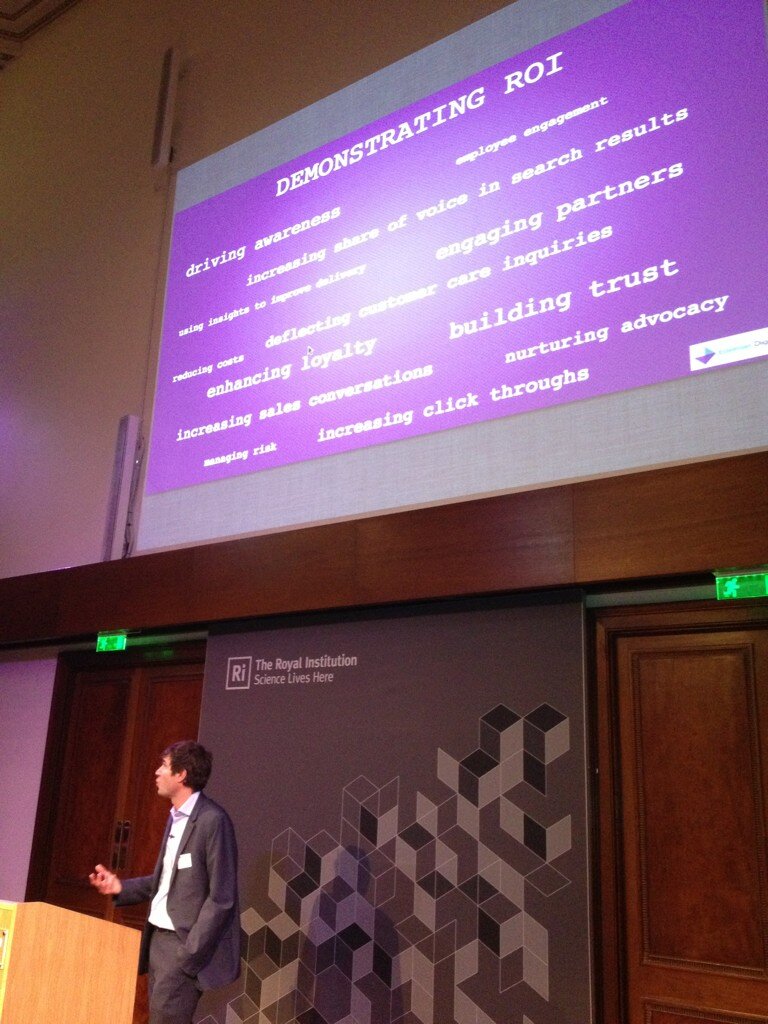
Still trying to work out how to get community ROI. Robin Hamman at Vircomm. Photo: HRW
Online communities, as Meg Pickard highlighted, have always had a darker side of bullying (trolls), Godwin’s Law, outrage, Lulz. But new trends and behaviours are emerging – kisses at the end of tweets for example, David Dimbleby style curating and hosting of debates, users becoming accountable for their words and actions and a focus on quality not quantity.
But fundamentally, the principles of community engagement remain the same and focus around relationships and connecting people to make something interesting happen. Here was John Coate’s summarising list of a good community manager:
- Don’t be authoritarian
- Try to influence and persuade
- Be affirming of people – find the best part in someone
- Expect fervor
- Leave room for making judgement calls
- Give people to tools to manage the experience themselves
To see more tweets from VirComm13 take a look at vircomm.n0tice.com.
Looking back on 2012 – one of my favourite community projects

One of the 52 weeks photos from Helen Ogbourn
Community builds up over time. One of my favourite projects of the year, which was based on noticing a sharing trend among an existing community and building on this over time, was the 52 weeks project.
I’ve written a blogpost about the project and what it entailed over on the Guardian photography blog here. And we made a special video to showcase some of the best images from the project embedded here.
You can see what it took to run the group in this post here. Overall it was incredibly rewarding, just look at the interactions between users on this opening introduction post and thoughts from users looking back on the year here.
Over Christmas I’ve had a number of messages from group members (of which there are more than 800 in total) thanking me for running the project. I think some of the reasons the project was so successful and brought joy to so many was due to the fact it was based on an idea which came from the community, was constructed in a way similar to other projects/groups I’d taken part in which worked well (such as project document, the 4am project and thing a week), encouraged members to reward and interact with each other through tip sharing and favouriting, regularly fed back to the community and took on board their suggestions to shape the project, and showed some of the outcomes of the project with weekly roundups.
Overall it’s been a great project to work on and I hope can inspire you to do something different which brings people online together in 2013. Happy New Year!
Guardian Facebook page as a network – @RiederB

Visualisation of links form posts on the Guardian Facebook page by Bernhard Rieder
I just wanted to share this awesome visualisation from Bernhard Rieder showing interactions on the Guardian’s main Facebook page. Read more about what it shows here and click on the image to zoom in to see the nodes.
He writes:
One can see a a core of regulars in the middle of the graph, but the main engagement comes from a large majority of users that have only interacted with a single posts. These users drag the big subjects out to the margins in this specific spatialization. Engagement, here, comes from a fleeting audience rather than a more stable group or community.
As someone who runs the main Guardian page and takes a keen interest in the ‘engagement’ and ‘reach’ figures for each post as well as running various stats reports, it’s nice to get this bigger picture overview of how our page works as a network. Nice stuff!


The bottom half of the internet: The counter-attack to the war on online comments
Disclaimer: This post was first drafted on 6 September 2012 in response to the Telegraph article mentioned. It was then put to one side and redrafted on 22 October 2012 in response to Ben Whitelaw’s great piece on the value of comments, then put aside again for a few months. I now feel it’s finally time to hit ‘publish’ after hearing Rob Manuel’s talk at The Story conference 2013.
Rounding up a great day of speakers who highlighted the importance of narrative, emotion, feeling, playfulness and passion in storytelling – Manuel ended with a face slap of an argument against the columnists and online haters who are currently staging a ‘war on comments’ on newspaper sites, and a ‘war on trolls’. Manuel’s brilliantly executed argument – which he has written out in full on his blog – left me feeling now was the time to publish this piece and rewrite my call to action at the end. Some of the examples are contextually relevant to the various times of writing.
There is currently a war on comments. The ‘bottom half of the internet’ – the place where the regular general public go to spew hate and bile into cyberspace (or so certain people are led to believe) below the untouchable ‘above the line’ prose of columnists and real-life paid journalists is being attacked from all sides. New headlines emerge staging a ‘war on trolls‘ and tweets urge you not to read the bottom half of the internet.
This war has been building up over the last two years. Engadget announced in 2010 they were switching off comments forever, Nick Denton announced plans to reinvigorate comments on Gawker by hiding the filth and floating quality to the top, and then Helen Lewis attacked online commenters on the New Statesman, which was followed by this great post ‘in defence of online comments‘ from James Ball. Only in the last month, Tech Crunch switched back from Facebook comments after realising real names really don’t make much of a difference, only to be swamped by more ‘trolls’ and baddies.
Respected journalist Paul Carr was tweeting about the horrendous comments on a news story about a journalist who died, followed by another attack on comments from the Telegraph’s Mic Wright entitled ‘Comments are the radioactive waste of the Web,’ which Mic actually said he could write a book about. Wright’s piece is a more considered and genuinely interesting unpicking of the value of comments which, for the first time in a while, led me to feel I would like to contribute my meagre two pence to the discussion. Read the rest of this entry »
Written by hrwaldram
February 23, 2013 at 8:22 pm
Posted in community, Online Journalism
Tagged with commenting, comments, community, journalism, news